


Indigenous Focus Day: Learning from the past and innovating for the future
This story is part of a series where staff participated in Indigenous Focus Day on April 20, 2026. Indigenous Focus Day is a District-wide professional development day dedicated to deepening educators’ understanding of Indigenous perspectives, histories and ways of knowing.
Introductions and the significance of land acknowledgements
On Indigenous Focus Day, staff gathered at Vancouver Technical Secondary School to learn and connect. To begin the day, host Julie Mendgen, a VSB District Resource Teacher, spoke about the significance of land acknowledgements in a political and educational context. Introducing herself as a European immigrant settler, she reflected on how she situates herself on the land she now calls home.
“I recognize that I come from European settler and immigrant roots, and that I grew up within systems that sustained and promoted a colonial status quo,” said Mendgen.
She explained that educators have a responsibility to advance Reconciliation, as outlined in the Truth and Reconciliation Commission’s 94 Calls to Action, and discussed how that work can be carried out in schools.
“This work cannot be confined to single moments or statements. It requires ongoing learning, careful listening, consultation and collaboration—especially with our local Nations—and a willingness to both learn and unlearn over time,” said Mendgen.
The workshops and keynote address that followed reflected this commitment to listening, collaboration and meaningful action. Speakers in both sessions shared first-hand experiences of negotiations and partnerships that resulted in significant change.
The Guerin Case
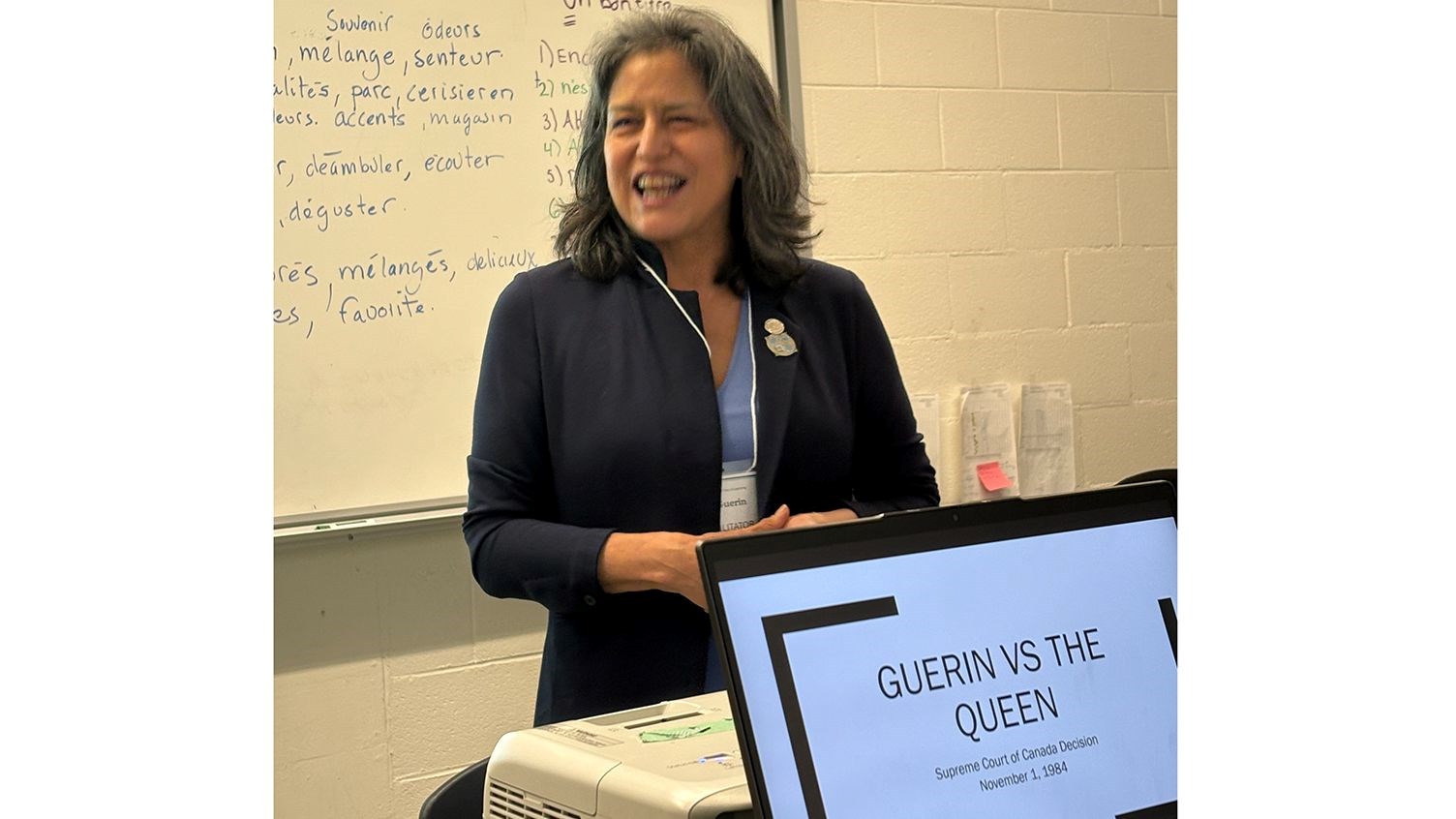
Kim Guerin, daughter of the late Delbert Guerin, facilitated a workshop on the landmark court case Guerin v. The Queen (1984), which established that the Canadian government has a fiduciary duty toward Indigenous Peoples in Canada.
Kim Guerin is also the granddaughter of Gertrude Guerin. Together, Delbert and Gertrude Guerin spearheaded the legal challenge, which took nearly 10 years to reach a decision. The dispute centred on the lease of reserve lands that are now home to the Shaughnessy Golf and Country Club.
Attendees had the unique opportunity to hear about the case directly from a family member who was closely connected to the historic legal battle.
Sean Owen, a teacher at Vancouver Alternative Secondary School, said he chose the workshop because of its relevance to his teaching.
“I've taught this case, so to have the opportunity to hear from somebody like the daughter of the person involved, who is also currently working in land use, provides me with more tangible knowledge that I can then share with my class,” said Owen.
Keynote Address by Chief Ian Campbell
In the afternoon, participants heard from Chief Ian Campbell, hereditary chief of Sḵwxwú7mesh Úxwumixw (Squamish Nation) and a graduate of Simon Fraser University’s MBA in Aboriginal Business and Leadership program.
Campbell provides land management leadership for MST Development Corporation, an alliance he helped establish. MST is a partnership between xʷməθkʷəy̓əm (Musqueam Indian Band), Sḵwxwú7mesh Úxwumixw and səlilwətaɬ (Tsleil-Waututh Nation).
“It wasn't until we reframed and said, ‘Let's work together.’ Then we're equal partners, 33.3 per cent each. It's pretty substantive,” said Campbell.
For Campbell, the success of the partnership is an example of adaptation.
“It doesn't mean we're assimilated. It simply means we're adapting and utilizing the best tools available,” he said.
Throughout his keynote, Campbell shared stories illustrating how Indigenous communities have adapted to changing circumstances while maintaining their identities and values. One example drew on teachings about the great floods and the Ice Age.
“Once that water receded, you could not go backwards to the way it was before the floods, before the Ice Age. You adapt. And that's where, again, you learn innovation and technology,” he said.
Campbell’s forward-looking message about shared responsibility, innovation and adaptability resonated strongly with attendees. His remarks also highlighted the important role Indigenous youth will play in shaping future developments across British Columbia. Through their leadership, new opportunities for collaboration, economic development and Reconciliation will continue to emerge.